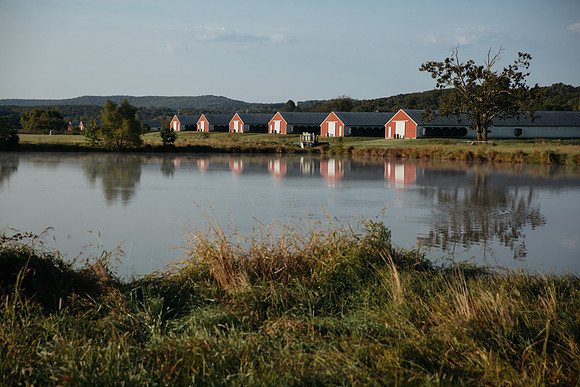
The 10 poultry houses sit above water quality monitoring stations, operated by the University of Arkansas Discovery Farm program, that measure nutrient levels in rainwater runoff before and after traveling through two conservation practices. The water is filtered through either an aerated grassed water way or travels through a large pond, effectively reducing nutrient loading by 26 and 70% of the soluble reactive phosphorus (also called dissolved phosphorus) and 64 and 55% of the total nitrogen, respectively, before flowing into the White River. Conservation partnerships between farmers, the Discovery Farm Program, USDA-NRCS, the Beaver Watershed Alliance, and other conservation groups, along with the adoption of conservation practices, help to reduce nutrient loading and conserve water resources in Elkins, Arkansas; USA on October 1, 2020. The Marley Farm is a participant in the Arkansas Discovery Farm Program which began in 2008 within Division of Agriculture at the University of Arkansas. The goal of the Discovery Farms program is to take a proactive approach to testing the effectiveness of water and soil conservation practices utilized on different farms throughout the state. The Marley Farm also works with the Beaver Watershed Alliance, a local non-profit group that was established in 2011 with the goal of improving water quality in the Beaver Lake Watershed which provides drinking water to 1 in 7 Arkansans.